
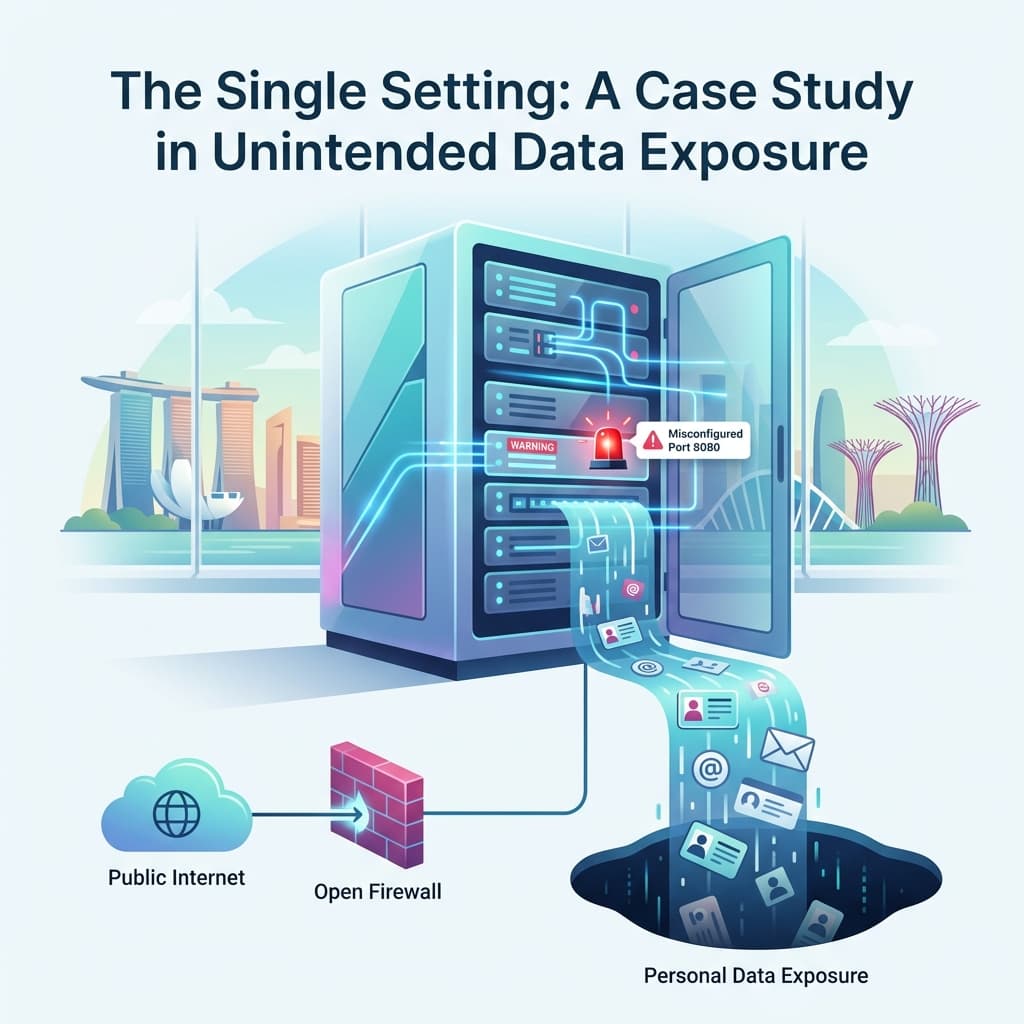
A lot of data breaches do not begin with something spectacular.
They begin with a web server left too exposed. A dormant application left online. A weak administrator flow. A firewall missing or badly configured. A patch deferred because there was no time. A test that checked whether the system worked, but not whether it was secure.
That is why recent Singapore cases are so useful for Data Protection Officers. They do not just tell us that systems can fail. They show how ordinary technical lapses become data protection failures when organisations hold personal data at scale.
The PDPC's April 2026 announcement highlighted a case involving unauthorised database access due to misconfigured security settings. The earlier Singapore Data Hub decision gives a fuller picture of how these failures compound. In that case, the organisation's systems were accessed on two occasions, with personal data of roughly 689,000 individuals at risk, including combinations of names, contact details, dates of birth and NRIC numbers. The findings pointed to public exposure, weak access controls, outdated software, limited logging, lack of proper network firewalling and inadequate security testing.
For DPOs, the message is not "be more technical." The message is "be more evidence-driven."
Why misconfiguration is a DPO issue
Many privacy programmes still focus on notices, consent, policies and response protocols. All of that matters. But if the organisation cannot show that the systems holding personal data are configured reasonably, the paper controls will not carry much weight after a breach.
Misconfiguration is especially dangerous because it often sits in the gap between ownership lines.
Security assumes engineering has hardened the service. Engineering assumes infrastructure has restricted access. Infrastructure assumes the vendor has covered defaults. The business assumes "it passed testing."
The DPO's value is in forcing the right questions to be asked before an incident makes those assumptions visible.
What the recent cases tell us
The Singapore Data Hub case is packed with practical lessons. According to the decision, the affected web servers were publicly accessible, multiple open ports were exposed, web directory listing was visible, application code was vulnerable to SQL injection, important credentials were insufficiently protected, and network segmentation was missing. The organisation had not conducted security testing for the relevant web applications as part of pre-launch testing or periodic review.
That combination matters because it reflects a governance problem, not just a coding problem.
The organisation had frequent changes going live. Yet security checks were not embedded into the release process. Acceptance testing focused on whether the application functioned properly, not whether it could be exploited. That is the kind of operational pattern DPOs should treat as a warning sign in any environment that processes customer, employee, student or patient data.
The hidden risk in "working" systems
A system can appear healthy and still be dangerously exposed.
Users can log in. Pages load. Data flows. Reports run. The product team sees stability. But a configuration review might show exposed ports, weak admin access, stale software, missing firewall rules or no segmentation between services.
That is why DPOs should be careful not to accept operational uptime as evidence of data protection.
When a vendor or internal team says a system is stable, ask a different question: when was the last security review, what was tested, what findings were raised, what was remediated, and what evidence exists today?
The DPO's practical checklist for misconfiguration risk
- Ask for a current inventory of internet-facing systems and web applications that hold or can reach personal data.
- Require evidence of pre-launch security review, not just user acceptance testing.
- Review whether dormant, training or legacy applications are still publicly accessible.
- Confirm whether firewalls, web application firewalls, MFA, encryption, network segmentation and logging are actually deployed and properly configured.
- Check whether software, libraries and infrastructure components are current and supported.
- Escalate situations where teams are making frequent production changes without corresponding security review.
Why this matters for SMEs and SaaS teams
One of the most important lessons in the recent cases is that regulators look at the nature of the organisation and the volume of data involved. A SaaS provider, CRM vendor, HR platform or digital service provider that handles large datasets is expected to implement security arrangements that fit that role.
That expectation is important for DPOs in growth-stage companies. If the business is scaling faster than its review discipline, the risk multiplies quietly.
What starts as a startup shortcut can later look, in an enforcement decision, like a basic security lapse that should have been fixed much earlier.
The DPO's opportunity
A good DPO is not expected to become the network engineer. But the DPO should know when to ask for proof, when to challenge assumptions, and when to insist that security review is part of operational governance.
Misconfiguration thrives in silence and handoffs. It becomes less likely when ownership is visible, reviews are scheduled, and evidence is current.
That is the real takeaway from the latest Singapore cases. The problem is rarely one wrong setting. It is the absence of a discipline that would have caught it before it mattered.
Key takeaways
- Misconfiguration is a governance risk as much as a technical one.
- User acceptance testing is not a substitute for security testing.
- Public exposure, weak access controls and unsupported software still show up in serious PDPC cases.
- DPOs should ask for evidence of review, remediation and ownership, not verbal assurance.
- Growth-stage teams should treat release speed and security review as linked, not separate.